Back to NEB

A Return to Campus Store Shopping and Profit
with Industry-Leading E-Commerce


December 2013


Why this matters:
  • Declining textbook revenue sends campus stores scrambling for new profit centers
  • Major e-tailers have set expectations well above the capabilities of smaller online stores
  • Student technology needs are extensive, but campus stores face huge challenges meeting those needs
  • Exploiting Newegg- Business solutions can put a campus store back into the game
Inside:
Moving Beyond Textbooks 1
Contending with the Big Boys 2
Excellence in E-commerce Matters 3
Any Campus Store Can Compete with Big-Box Retailers 4

PDF Download
Download
A NeweggBusiness White Paper

Old School Meets New School at the Campus Bookstore

In times past, campus bookstores could count on student traffic and revenue since there really were no alternatives within reasonable reach. Students could only buy textbooks and most course materials at the campus store. The Internet has changed all that for many captive markets, as it has for this one. Dogged by new competition within easy reach of students—even from within the dorm—campus stores have been undergoing massive changes in recent years.

Rapidly increasing textbook prices are driving students online to find better deals, taking associated revenue to other retailers. Despite this online pressure, campus stores can count on some level of sustained business by students who choose not to risk the complications of purchasing the wrong textbook or course materials through another merchant. Indeed, the ability to return these to the campus store and obtain other textbooks if they change courses within a few days keeps some students coming back. Even so, the stark budget of most students presents strong motivation to find lower-cost alternatives.

The textbook industry is showing cracks due this and other pressures. The June 2013 Chapter 11 bankruptcy filing of Cengage Learning, a textbook publishing company, may be evidence that the limits of traditional textbook pricing have been reached. Free learning materials through movements such as open educational resources (OER), the Open Course Library, and OpenStax College all compound the revenue evaporation from textbook markets.

Striving to replace the lost revenue, many bookstores have introduced new merchandise categories and engaged vendors to provide campus-branded online stores of their own.

Nonetheless, the e-commerce shopping experience and product pricing typically lags far behind what students and faculty have come to expect through their own online shopping experience.

Moving Beyond Textbooks

Moving Beyond Textbooks

Expanding into new product lines follows traditional business sense; offer more products to existing customers. Campus stores have of course been doing this for many years with insignia products, supplies, food, and other small items.

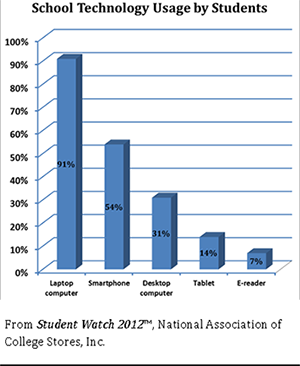
Some stores have added selections of technology for obvious reasons. According to Student Watch 2013™, a study underwritten by the NACS Foundation, 91% of students use a laptop for schoolwork. In addition, Student Monitor reports that their studies reveal that one million students intend to buy a new computer in the next 12 months. Then there is the endless need for flash drives, printers, supplies, peripherals, and other related electronics. Technology offerings might therefore be obvious categories to offer through the campus store.

The challenges a campus store faces in bringing on such technology lines quickly become apparent. Space for stock and display, investment in inventory, and product knowledge are just a few.


Page 2


Every student has technology needs and typically has to shop off-campus to satisfy them

Some products call for a level of support as well. Additionally, many categories will require a selection of options to satisfy the variety of needs and preferences.

Some vendors have attempted to ease the challenges by including other categories in their online store offerings to campuses. These additional lines typically consist of one or two brands for that category, providing an uninviting selection akin to corner markets attempting to cover all the basics.

Consider a likely shopping experience: A student has a Brother™ printer and needs to replace the toner cartridge, which is a commonly available TN-360 cartridge. Through a quick check of the bookstore Web site, the student will find it is not available since none of the major online college bookstore vendors stock this otherwise common consumable. The student then checks for a color HP 564 cartridge for his ink printer. He finds it, but only the full-price HP original cartridge is available. The vendors do not stock money-saving compatible or remanufactured cartridges, which cost less than half the price of the original HP while providing more profit for the store. The student ends up locating the needed products at other more familiar online retailers and the revenue therefore flows off campus.

Having had that experience, will the student be inclined to start at the bookstore the next time he needs some technology products? Most likely not since his first experience revealed a slim selection and full retail pricing.

Contending with the Big Boys

So-called academic pricing, which provides students much-needed savings, can be a strong motivator for them to persevere through appallingly antiquated shopping methods. For example, some otherwise famous institutions of higher learning infamously require students to download an Adobe® Acrobat® document and fill it out to order computer products online. Some link directly to manufacturer Web sites such as

School Technology Usage by Students

Apple.com where students quickly find that the discounts are meager, if they exist at all.

Presumably, shopping with the campus bookstore should bring students great deals. Armed with price comparison apps, browser add-ons, and Web sites, students soon learn that the major online retailers they have always dealt with usually continue to be the lowest-cost source. Bookstores and their vendors simply do not have the volume of sales needed or the negotiation wherewithal to attract the best up-to-the-minute pricing from manufacturers.

Conversely, major online retailers have developed massive buying power. Eager to move their products in high-volume, manufacturers provide deeper and deeper discounts to online retailers that are then able to sell the merchandise at near fire-sale prices. Low-price reputations often cement customer loyalty and prevent other retailers from even being noticed by shoppers the next time they go shopping.

The big boys of online retail have another advantage over small campus stores; they are able to offer a broad selection. For example, while many campus stores have an arrangement with Apple®, few have any arrangements to enable students who wish to purchase an Android™ tablet—despite the reports that Android-powered tablets have overtaken Apple tablets in market share as of the second quarter of 2013.


Page 3


Online Shopping
Priorities:
  1. Price
  2. Ships out fast
  3. E-tailer reputation
  4. Customer service
  5. Ease of ordering
Excellence in E-commerce Matters

Major online retailers have invested heavily in refining the user experience in ways that increase sales and customer satisfaction. Large e-commerce sites constantly run tests of major and minor changes, seeking even the slightest improvements. Meanwhile, feedback mechanisms and surveys provide preferences for features, services, and customer service needs that bring ever-greater customer satisfaction.

As online retailers implement refinements, customers come to expect them in all the sites they visit. For example, in early e-commerce sites, additional product suggestions based on what a shopper was looking at or had just put in their cart were only seen on the largest sites. While the techniques to accomplish this were advanced and aimed at increasing order size through upsells, there were also concerns that it could annoy shoppers. However, when executed properly, customers actually appreciate it and do in fact spend more on the intelligently suggested supplemental products. Now the feature is expected and customers have been known to send feedback to site owners lamenting the lack of suggestions reminding them of items they may need to go along with their current purchase.

While advanced features such as product suggestions have come to be expected, surveys and the evidence from many online stores repeatedly highlight the priorities of price, fast

Fast Shipping

shipping, and great customer service. The best online retailers have therefore mastered these key qualities valued by customers. Small stores will have the greatest difficulty with the first of these, however.

Pricing products in an online shopping world has developed into a dynamic that experienced e-commerce retailers have perfected. Shoppers use a plethora of browser tools, shopping sites, and discount and coupon Web sites to track down the right products at the right prices. Student budgets and social buzz feed this frenzy as they tip each other off about the best sites and deals.

Only e-tailers with the greatest purchasing power can consistently provide the shopping values that customers come to trust and return for regularly. These are able stay in touch with the latest product launches, monitor constantly changing prices for products, and demand the wholesale pricing and volumes that keep their customers coming back.

Experienced online retailers have also learned to supply adequate information for customers to make a buying decision. At variance with this best practice, most bookstore Web sites feature lean product descriptions with no user reviews—a shortcut that sends shoppers to other Web sites for additional information to aid them in their selection. This significantly increases the risk that a shopper will find the product at another site with the bookstore thereafter losing the sale.

Refinement of fulfillment logistics to a well-oiled machine is necessary for the fast shipping times of the best e-tailers as well. The moment a customer places an order, it needs to move into the process and be on its way to the customer in as little time as possible—certainly in less than 24 hours. Within this short window of time, fraud checks, payment verification, picking, packing, and hand off to the shipping carrier needs to happen like clockwork.


Page 4
Any Campus Store Can Compete with Big-Box Retailers

While identifying alternative profit centers for the campus bookstore has become a priority in the face of declining textbook revenues, their plausibility for any given institution is often decided not only by the availability of investment funds, but also by access to the necessary skills to implement the profit center. The very fact that many institutions decide to engage outside vendors to operate their bookstore demonstrates recognition that a focus on core competencies and capability to compete with the marketplace that is accessible on and off campus are considered keys to success.

NeweggBusiness, a unit of the second largest online-only retailer in the US understands these challenges faced by many institutions and has engineered a solution. The NeweggBusiness Campus E-Store draws on years of e-commerce experience, competitive ingenuity, and the merchandising influence of a retail powerhouse.

The NeweggBusiness Campus E-Store is quite literally a copy of NeweggBusiness' own e-tail store inner workings wrapped in a campus store's look, feel, and branding. It serves as an extension to the store's own Web site, adding an annex of more than 80,000 products. NeweggBusiness builds and maintains it free of cost and provides the campus' institutiion a revenue share on every product sold.

The NeweggBusiness Campus E-Store provides an industry-leading shopping experience. Moreover, features and functions are constantly updated to keep pace with shopper's expectations. Product descriptions are extensive and accompanied by reviews from real users and experts. Many have in-depth specifications and videos to assist shoppers with buying decisions.

With a legacy in technology, the NeweggBusiness Campus E-Store draws from our broad and fast-moving inventory to keep students and faculty supplied with everything they need for computers, laptops, tablets, TVs, cell phones, and electronics of all kinds. Since we negotiate with top manufacturers on a daily basis, we can provide top-rated and popular products, including availability for pre-order and on date of new product launch. And, NeweggBusiness' massive buying power means the Campus E-Store can offer extremely competitive pricing that often beats academic-priced offerings found through most bookstores.

On autopilot from the sponsoring institution's perspective, NeweggBusiness systems and staff run ongoing promotions to drive traffic and sales. These promotions can mean even deeper savings for Campus E-Store shoppers since they are frequently sponsored by leading manufacturers. From the moment an order is placed, the NeweggBusiness world-class fulfillment systems and logistics professionals make sure that 99% of all orders ship within a day or less. Coupled with top-rated customer service, the shopper's experience meets their ever-escalating expectations.

A new scenario can therefore emerge for campus bookstores wishing to engineer a return to campus store shopping and profit. Decisive to this competitive edge against the big-box retailers is industry-leading e-commerce and lines of technology products clearly popular with students and faculty members; all provided free of setup or maintenance costs by the NeweggBusiness Campus E-Store.

NeweggBusiness.com
The NeweggBusiness Campus E-Store is a free Web site extension that any campus store can attach to their existing Web site. Contact us for additional information.

© 2013 Newegg Business Inc. All rights reserved.

NeweggBusiness


18501 E. Gale Ave., Suite 150
Phone: 626.271.1321 ext. 23397
Fax: 626.271.9558
E-mail: Doug.A.Garcia@Neweggbusiness.com