


|
Plasma TV Buying Guide Table of contents
Plasma TVs are flat, super high-contrast TV sets that are offered in very large sizes, which at the extreme end can exceed 60 inches to provide the one of the most immersive theater-like viewing experiences you can get in the comfort of your own home. In addition, plasma TVs are also extremely thin, offering flexible placement options from custom stands to the wall of your living room.
Immersive theater-like screen sizes At the larger end of the scale, plasma TVs come in sizes exceeding 60 inches. This helps the plasma TV to provide an immersive, "theater-like" experience right in your own living room! Space-saving design Though plasma TVs are offered in impressive sizes, their thicknesses are dramatically thin by comparison – only a few inches. This allows plasma TVs to be hung from the wall – a fashionable installation method that opens up the space beneath it for a variety of other gadgets or toys. Absolute flat screen With the Plasma TV's perfectly flat screen, picture distortions owing to screen curvature are a thing of the past. Astonishing picture quality Plasma TVs provide very rich, saturated colors, extremely high contrast ratios and wide viewing angles to maximize your viewing enjoyment. Plasma TVs are often found in high-quality video systems like high-end home theaters, retail or public displays, or exhibition screens. Ready for DTV DTV (Digital TV) is poised to gradually replace standard analog TV. Plasma TVs can support DTV signals with a built-in or external digital tuner. Most plasma TVs can support at least EDTV (Enhanced Definition TV, 480p), which provides superior picture quality to regular analog TV. HDTV Capability Plasma TVs are great for displaying HDTV pictures as they are designed to be HDTV compatible or HDTV ready by featuring a 16:9 widescreen aspect ratio and very high native resolutions. Please refer to the Screen Resolution section below for more details. Screen size Plasma TVs are sold no smaller than a 32 inch diagonal measurement, and can reach as large as 103 inches!. Currently, the most popular plasma TV screen size is 42", but larger sizes such as 50, 55, 60 and 65-inch sets are also generally available. The larger the screen, the more it will lighten your wallet. The relationship between Screen Size and Viewing Distance Although many of us hope to purchase the largest TV we can afford, this actually isn't recommended. The proper size TV to purchase should be a function of the distance you sit in relation to the TV screen. For example, a 1 foot distance between you and a 42-inch Plasma TV will most likely feel very uncomfortable. A distance of 5 ~ 10.5 feet from the same 42-inch Plasma TV will provide a much more comfortable viewing experience and still maintain the immersive qualities of the large screen. The following table provides a quick reference for the relationship between screen size and the viewing distance, measured from the screen of the Plasma TV.
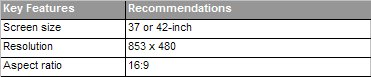
These are only recommendations - please find a viewing distance that best suits you. Screen Resolution Every displayed pixel on the plasma TV screen corresponds directly to a physical pixel on the plasma panel. Each pixel on a horizontal line multiplied by the number of vertical lines gives you the native resolution of the plasma TV. At current, 852 x 480 is the frequently applied resolution on relatively small plasma TV sets, such as 37" and 42"; while higher native resolutions (e.g. 1024 x 768, 1366 x 768) are available in larger plasma TV sets. Aspect ratio The aspect ratio of a TV is its width to height proportion. 4:3 is the aspect ratio for standard televisions. This corresponds to 3 inches of height for every 4 inches of screen width. Contrast ratio In scientific terms, contrast is the ratio between the light intensity of the brightest and the darkest points in an image. What it does in practice is to allow a screen to show both light and dark details as well as possible. A higher contrast performance often allows darker details to show better and therefore improves picture quality. The viewing angle refers to the maximum angle (horizontal or vertical) from which a user can view a plasma TV screen at acceptable image quality. Currently, most plasma TVs are capable of at least 160o/160o (Horizontal / Vertical), and some are able to exceed 170o/170o (H / V), which allows a large number of people to view the screen from many different angles. Every plasma TV offers several types of input connector allow signal sources such as a TV antenna, cable TV line, and other units like a DVD player or gaming console to connect and provide a picture. If, for example, you want to output your PC's picture to your plasma TV, you will need your plasma TV to come equipped with either a DVI or D-Sub port. For DVD players you can work with composite connectors, but component connectors are recommended for better image quality. For in-depth information, please see our Plasma TV Connector Guide. The future of TV is definitely Hi-Def. At the current time, only a portion of plasma TVs sold are HDTV ready or HDTV compatible. This means that they are able to display HDTV resolution images, but do not feature an HDTV tuner - this requires owners to purchase an external HDTV tuner separately in order to provide the TV with an HDTV picture signal. Some plasma TVs come with built-in speakers and generally provide acceptable sound quality. Others models do not provide speakers, and are more suited for use by individuals or families that own independent sound systems. Users also have the option of purchasing optional external speakers. Please be sure to look at each plasma TV's detailed specifications carefully. On a budget Extremely high specs aren't what we are looking for here, but one of the advantages of the plasma TV is that picture quality is still satisfying without them. Plasma TVs that fall within the range of specs in the table below may make great choices for users on a budget:
These specs meet the requirements for DTV (Digital Television) and are at 480p EDTV (Enhanced Definition TV) quality level.
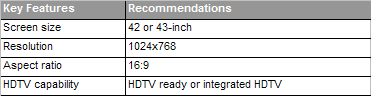
Mainstream Mainstream users want to experience the pleasures of the plasma TV, with its high picture quality and large immersive screen. In addition some flexibility and future-readiness is desired, such as HDTV compatibility. The recommended specs are listed as below:
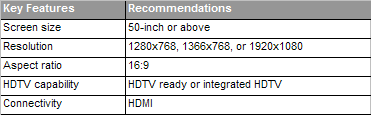
Movie Buffs Movie fans are more demanding in terms of picture quality and performance so as to ensure that their TV sets do full justice to the DVDs or High definition content they will display. Also needed is a digital interface to hook up a digital high definition content player. Of course, a larger screen size is always better.
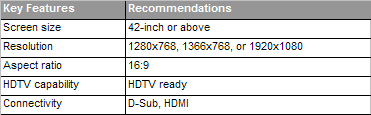
Gamers Microsoft's new Xbox 360 and the upcoming Sony PlayStation 3 both support HDTV output. To enjoy the picture quality offered by these next-gen consoles, a gamer’s television set needs to provide high native resolutions and the proper input connectors such as HDMI.
Computer/HTPC Users LCD TVs are great choices for HTPC (Home Theater PC) users who use their computer primarily for movies and games. As a result, the recommended features and specs are similar to those for movie buffs and gamers. Of course, the LCD TV should provide standard computer connectors, namely the DVI and D-Sub (VGA) ports.
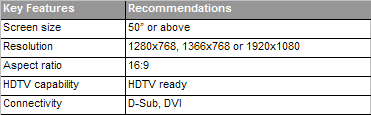
Office Users Office users typically use TVs for video conferencing, presentations or training videos. Mainstream specs will do fine here, but computer connectors are recommended to allow it to receive a picture from computers as well.
|









Who We Are
Who We Serve
Customer Service
B2B Marketplace
Newegg Logistics

© 2000-2026 Newegg Business Inc. All rights reserved.
Policy & Agreement | Privacy Policy | CA Transparency in Supply Chains Act | Cookie Preferences